
America’s Vicinity and Beyond
A Few Years Back

The world’s fastest-shrinking populations are in Eastern Europe1, Northeast China2, and Cuba. Between 10-20 percent of Cubans have left the island since 2020. Cuba today has one of the world’s oldest populations, with the highest median age in the Americas and a fertility rate of approximately 1.4 children per mother. Even in Florida, which has the oldest population of any significant American state, the median age is slightly lower than Cuba’s3. Raul Castro, now 95 years old, is partly responsible for this.
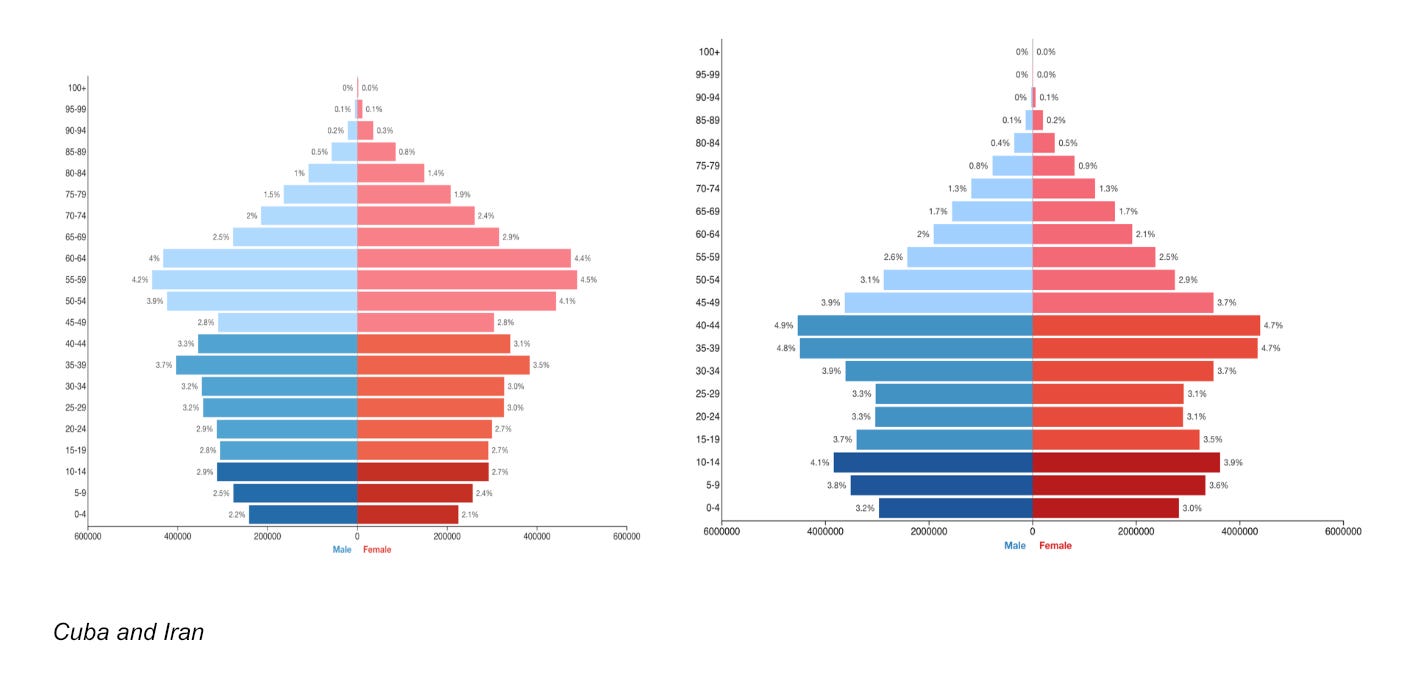
The biggest cohort of Cubans today are between 50-65 years old, born soon after the Castros came to power. Miguel Diaz-Canel, currently the country’s first post-Castro president and Communist party leader, is 66. He was born in 1960, between Fidel’s rise in 1959 and the CIA’s failed Bay of Pigs invasion in 1961.
During the Cuban Missile Crisis in October 1962, Donald Trump was a sophomore at the New York Military Academy in Cornwall-on-Hudson. (Trump’s roommate at the time, Art Davie, would later found the UFC, after volunteering to serve in Vietnam). A few months before JFK gave his famous oval office address during the missile crisis, he spoke at the graduation ceremony at West Point, only 5 miles away from the military high school. Trump was just starting his senior year there when JFK was assassinated in 1963.
John Bolton was also a student at a private military academy during the Cuban missile crisis, when Americans were worried about the possibility of WWIII. 40 years later, after George W Bush named Iraq, Iran, and North Korea the “axis of evil” in his 2002 State of the Union address, Bolton added Cuba, Syria, and Libya to the list, in the “beyond the axis of evil” speech he delivered at the Heritage Foundation. At the time, Bolton was Colin Powell’s Under Secretary of State for Arms Control and International Security. He gave this speech six days before Jimmy Carter became the first US president (former or sitting) to visit Cuba, since Coolidge in 1928. Obama later visited in 2016.
Though Bolton was fired by President Trump after about a year and half on the job, he remains the longest-serving of Trump’s six National Security Advisors. Trump’s first, Michael Flynn, only lasted 24 days in 2017, before pleading guilty to making false statements to the FBI, and later receiving a presidential pardon4. The latest National Security Adviser to be fired, Mike Waltz, lasted four months in 2025. Since that time, Marco Rubio has served jointly as Secretary of State and National Security Advisor. Rubio is the only person to fill both positions simultaneously since Henry Kissinger in 1975.
Before Bolton, H. R. McMaster was National Security Advisor for over a year.5 McMaster resigned in March 2018, days after Secretary of State Rex Tillerson was fired by Trump. Bolton took over in April, one month before Trump withdrew the US from Obama’s Iran nuclear deal.
The timing of Trump’s withdrawal from the nuclear deal probably reflected events in the Middle East more than it did Bolton’s hawkishness. ISIS had captured Mosul in Iraq and Raqqa in Syria in 2014 (a year before the nuclear deal was created), before losing these strongholds to a coalition of forces backed by the US and Iran between July-November 2017. The defeat of ISIS led predictably to a re-heightened conflict between the US and Iran.6 This occurred first in March 2018 when Trump pulled out of the nuclear deal, and continued in 2019 after ISIS lost what little territory it had left. The US assassinated Iran’s Qasem Soleimani in Baghdad on January 3, 2020, only two months after killing ISIS caliph Abu Bakr al-Baghdadi in Syria.
Soleimani had led the Iranian Revolutionary Guard Corp’s Quds (Jerusalem) Force from the late 1990s until 2020, in charge of Iran’s “axis of resistance” foreign operations. After Bolton served as Trump’s National Security Adviser between 2018-2019, he and former Secretary of State Mike Pompeo were allegedly the targets of an Iranian assassination plot, intended to be retaliation for the American drone strike that killed Soleimani.
Coincidentally, on the occasions when US and Iranian interests overlapped relatively closely – immediately after 9-11, and again after ISIS reached its zenith in 2014-2015 – it was Soleimani who helped pursue the US and Iran’s shared goals, and Bolton who helped signify the ruptures that followed immediately upon the achievement of those goals.
In October 2001, Soleimani played a key role in ousting the Taliban from cities in western Afghanistan, before the US and Iran began to fall out again around the time of the axis of evil speech. In 2014, Soleimani helped organize Iraqi Kurdish and Shia cooperation to protect Baghdad and Erbil from ISIS, a period of US-Iran coordination that ended soon before Bolton’s hiring in early 2018.
The defeat of ISIS also led to tensions between the US and Turkey. In January 2018 the Turks and their allies in Syria launched the Afrin offensive against the Kurdish YPG, the US-allied group that had led in the reconquest of Raqqa from ISIS.7 Turkey has occupied Syrian border towns like Barisha – where US commandos later killed al-Baghdadi – since that offensive.8 Turkey also continues to control territory in Iraq, where it is attempting to build infrastructure that could help oil and gas reach European markets without having to pass through the straits of the Persian Gulf or Red Sea.
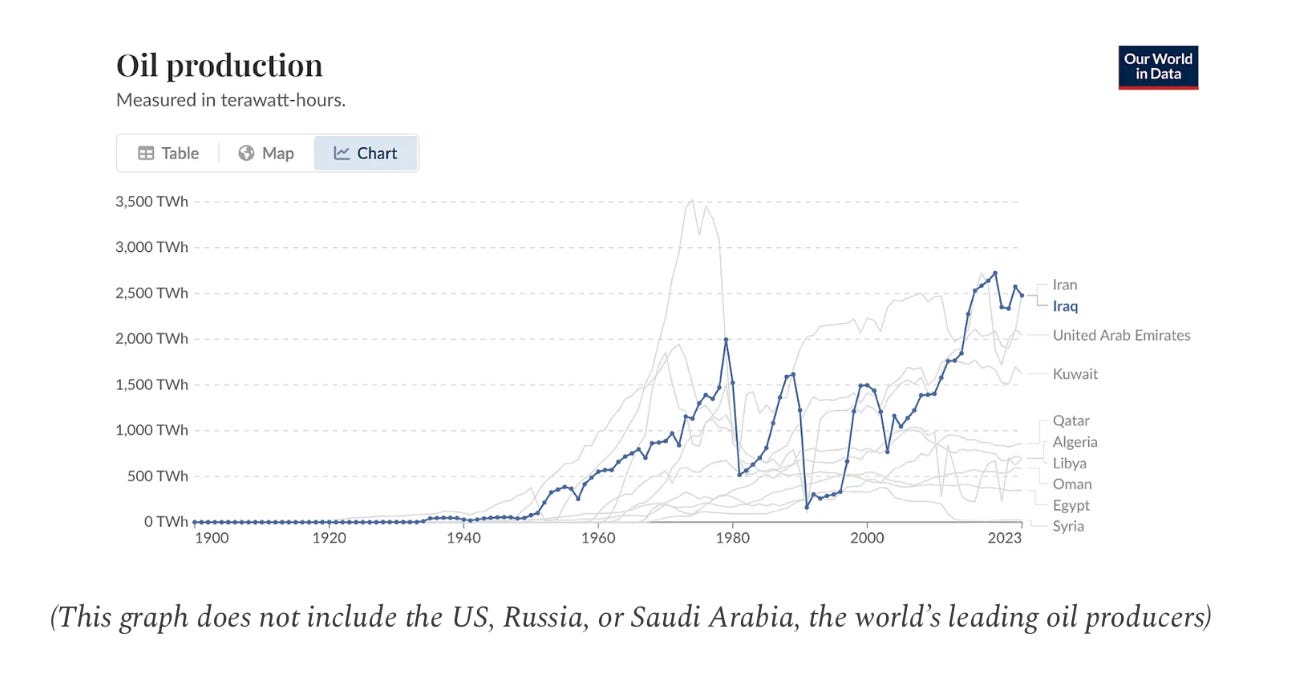
On July 7-8, Trump travelled to Turkey for a NATO conference, the first visit by an American president since Obama in 2015.9 (Biden never went to Turkey; in 2021 Biden became the first president to recognize the 1915 Armenian genocide, several months after the 2020 war between Armenia and Turkish-backed Azerbaijan)10. It is being reported that Trump may now remove the US ban on selling Turkey F-35 fighter jets, which he had earlier put in place in 2019 in response to Turkey’s purchase of the Russian S-400 missile-defense system.
Given how the 2026 war with Iran has turned out thus far, the US might attempt to lean more heavily on Turkey to counterbalance Iranian influence, rather than continue to rely primarily on smaller allies like Israel, the Gulf Arab states, and Kurdish forces, who are wary of Turkey.11
After the Korean War began in 1950, the US began building the Incirlik Air Force base on Turkey’s southeast coast, near the Syrian border. Turkey and Greece joined NATO in 1952. In the summer of 1953, just as the fighting in Korea was ending and the Castro brothers’ revolutionary movement in Cuba was beginning, the US and Britain organized a coup against Mohammad Mossadegh, who had become prime minister of Iran in 1951.
In 1959, a month after the Cuban Revolution on New Year’s Eve, Turkey, Greece, and Britain made a deal that led to the independence of Cyprus. At the end of 1959 Eisenhower became the second US president, after FDR during WWII, to visit Turkey. Eisenhower was the first career general to become president since Ulysses S Grant, and he had been elected in 1952 on a pledge to “bring the Korean War to an early and honorable end”. Upon his visit to Turkey at the end of his presidency, the US placed Jupiter missiles at the Çiğli Air Base. Two years later, during the Cuban missile crisis, President Kennedy agreed to secretly remove those US missiles from Turkey, in return for the Soviets openly removing their own from Cuba.
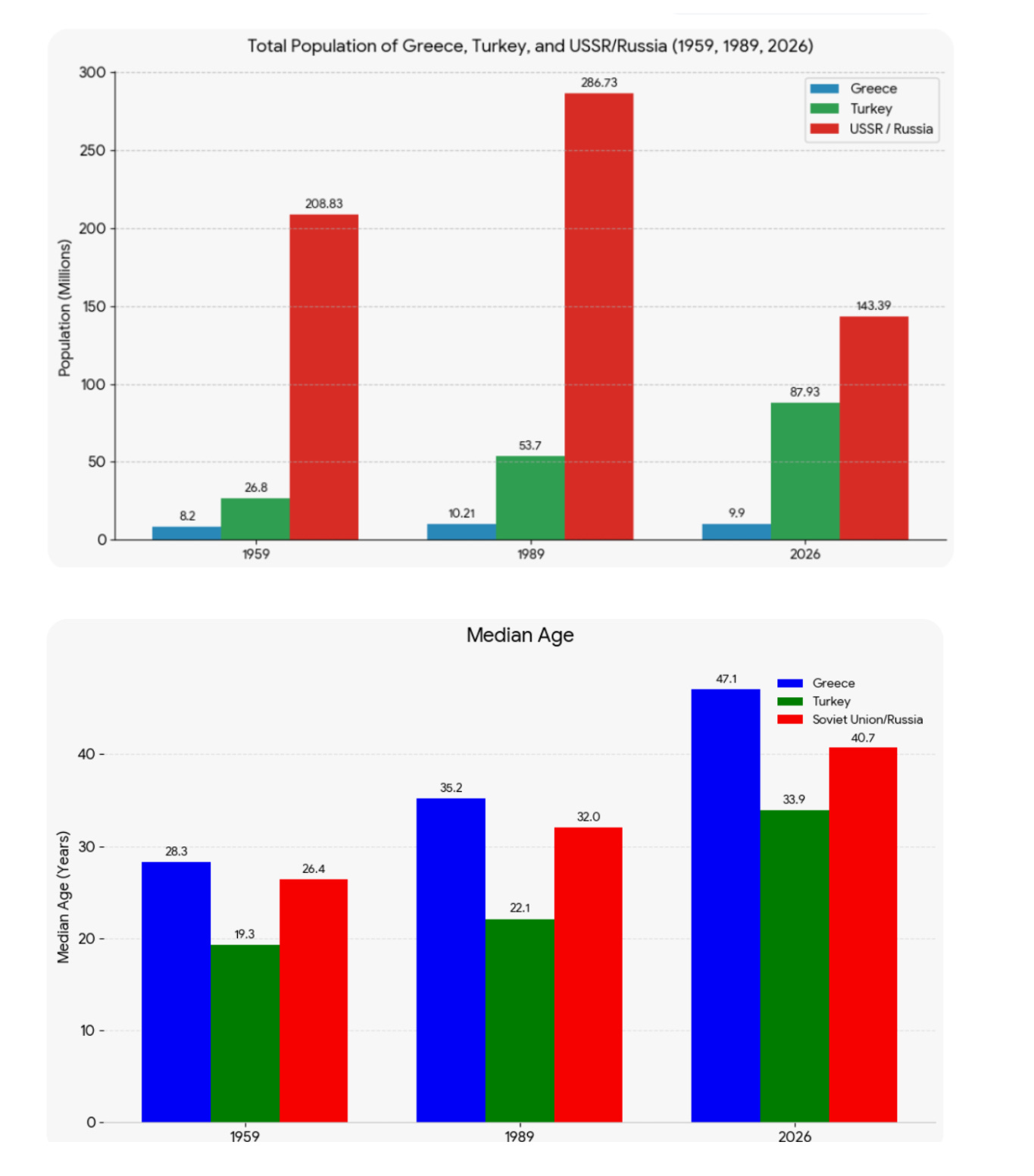
At the end of 1958, Oman gave up control of its coastal enclave of Gwadar, at the northeastern entrance of the Persian Gulf. It sold the enclave to Pakistan, which had just experienced its first ever military coup the previous month. Gwadar was the one of last remnants of Oman’s sea-empire; the only enclaves that Oman still controls today are the ones on the Strait of Hormuz, surrounded by the United Arab Emirates.
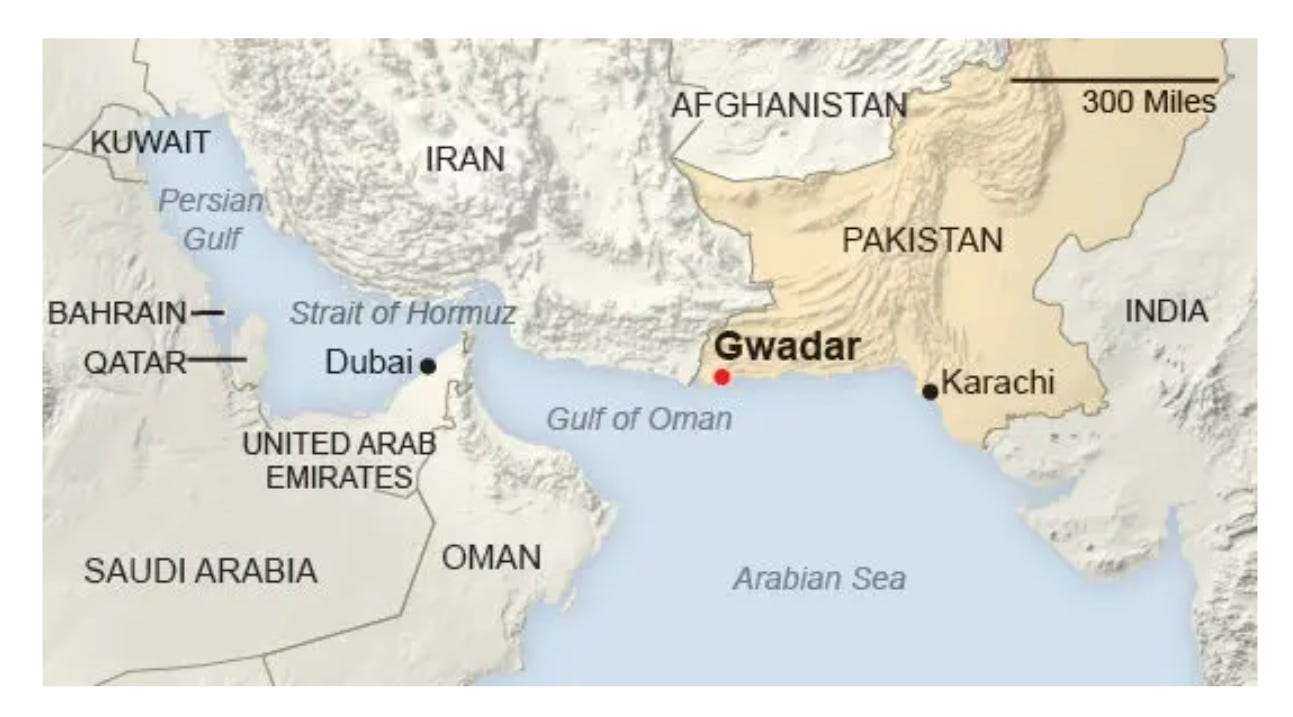
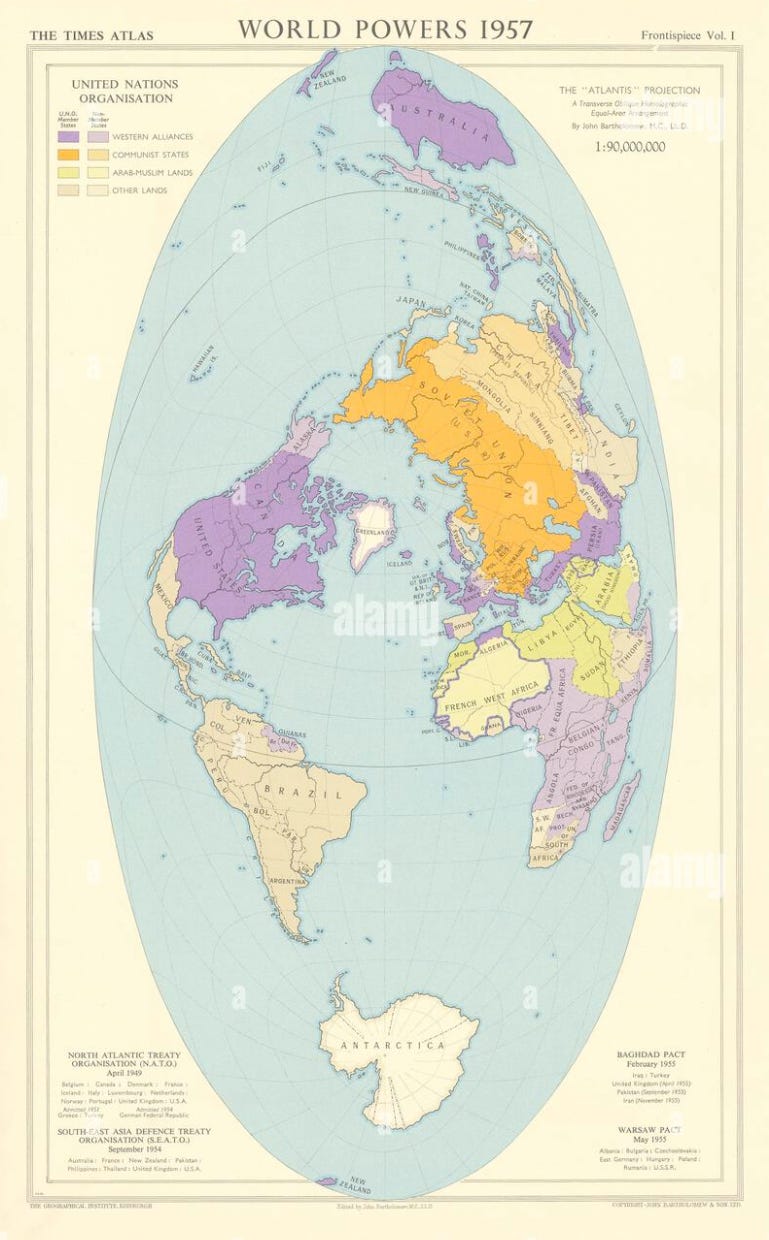
Pakistan was the eastern end of America’s European and Middle Eastern belt of allies, encircling the populated areas of the Soviet Union. This belt was threatened, to a certain extent, in July 1958, when the 23-year-old king of Iraq, Faisal II, was overthrown and killed, along with his prime minister and much of his royal family. This revolution brought the Anglo-allied kingdom of Iraq to an end. It left Jordan, ruled by Faisal’s 22-year-old second cousin Hussein, the last remaining Hashemite kingdom.12
Five months to the day before the Iraqi revolution, the kingdoms of Iraq and Jordan joined to form the Arab Federation; a merger that did not outlive the overthrow of Iraq’s monarchy. The young Iraqi and Jordanian kings formed the federation as a counter to Egypt and Syria, which created their own United Arab Republic a week later. On July 15, 1958—one day after the Iraqi revolution—approximately 1500 US Marines landed on the beaches near Beirut, to support Lebanon’s Christian president against factions that wanted Lebanon to join with Egypt and Syria’s United Arab Republic.
Egypt and Syria had become closer to one another in October 1957, after Turkey stationed soldiers on Syria’s northern border, threatening to invade it because of Syria’s ties to Moscow. Egypt’s president Abdul Gamal Nasser, who had himself come to power in a revolution that overthrew Egypt’s monarchy in 1952, responded by sending 1500 or so Egyptian troops to Syria, as a show of support for the Syrian government.
Their United Arab Republic, consisting of Egypt, Syria, and Gaza, was territorially discontinuous, its constituent parts separated from one another by their rivals Israel and Jordan. In this way the Middle East was a smaller mirror image of the nearby Indian subcontinent, where prior to the wars, disasters, and large-scale massacres of 1971, America and Britain’s ally Pakistan still included East Pakistan (today’s Bangladesh, in eastern Bengal), but was physically separated from East Pakistan by about 2000 km of India’s territory.13
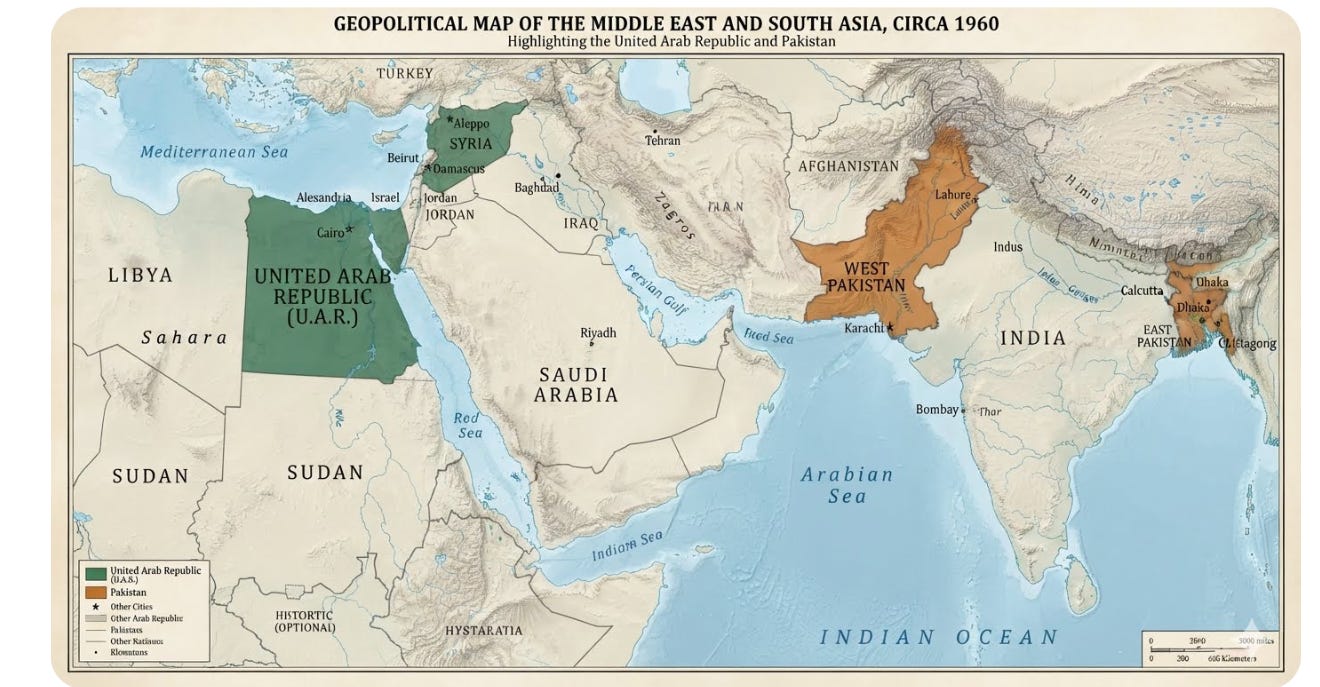
The United Arab Republic lasted longer than Iraq and Jordan’s short-lived federation, but Syria pulled out of it following another coup in 1961. Hafez Assad, at the time a 31-year-old Air Force officer, was then demoted to a desk job by the new Syrian government, which did not approve of Assad’s pro-Egyptian political position. Syria’s former president Al-Quwatli later died of natural causes in June 1967, three weeks after the country lost the Golan Heights to Israel in the Six-Day War.
Approximately 148,000 Syrians lived in the Golan before 1967. One of them was the grandfather of Syria’s current president Ahmed al-Sharaa, who had owned 0.6 square km of land very close to the Sea of Galilee, where the Israeli town Afek is now located. During the 2000s, a company called Afek Oil and Gas briefly announced that it had found significant quantities of oil in the Golan Heights, but these later proved to be economically unviable. Afek was a subsidiary of Genie Energy, an American firm whose advisory board included Dick Cheney (in 2009), Rupert Murdoch, former CIA director James Woolsey (who died five days ago, in his mid-eighties; his widow attributed his failing health to Havana Syndrome), and former Treasury Secretary Larry Summers.
Afek’s Oil’s president, Effi Eitam, was a hero of Yom Kippur war in the Golan Heights, one of the leaders of the daring Entebbe raid in Uganda, and led an elite unit in southern Lebanon prior to the Israeli withdrawal in 2000. He was also the key figure involved in one of Israel’s major scandals during the First Intifada in 1988, when soldiers beat a Palestinian prisoner to death. As a politician in 2006, Eitam said, “We’ll have to expel the overwhelming majority of West Bank Arabs from here and remove Israeli Arabs from political system”. (Attorney-General Menachem Mazuz warned Eitam at the time that criminal charges could be brought against him if he repeated the statements, according to Wikipedia). In December 2008, the small party Eitam led merged with the Likud party. In 2009, Likud’s Netanyahu became Israel’s new prime minister.
Hafez Assad took over Syria in November 1970, six weeks after Nasser passed away on September 28. The day before his death, Nasser had led the Arab League’s attempt to mediate an end to the Black September war in Jordan and the Jewish hostage crisis of September 11-30. Both had been triggered by the quadruple airline hijacking of September 6 1970, by the Popular Front for the Liberation of Palestine. Jordan, after fighting a brief war with the Palestinian Liberation Organization (PLO) and Syria, expelled the PLO to Lebanon in 1971. This was followed by the 1975-1990 Lebanese civil war, and the long Syrian and Israeli occupations of Lebanon between the 1970s and 2000s, during the era of Hafez al-Assad’s rule in Damascus and the rise of the Likud party in Jerusalem.
When America celebrated its 250th anniversary, Israel marked the 50th anniversary of its July 4, 1976 raid in Entebbe, Uganda. The only casualty the Israelis suffered freeing the Jewish hostages on that occasion was the rescue mission’s commander, Yonatan Netanyahu.
The Palestinian militias’ response to Israel’s capture of the West Bank and Gaza in 1967, and to Jordan’s Black September war against the PLO in 1970, also included events such as the 1971 assassination of Jordan’s prime minister Wasfi Tal in Cairo, the May 1972 Sabena airplane hijack (where Benjamin Netanyahu was shot in a rescue operation led by Ehud Barak), the May 1972 Lod Airport massacre (whose perpetrator, Kozo Okamoto, died a few days ago), the Black September 1972 Munich Olympics massacre, and the October 1972 Lufthansa hijack.14 The Lufthansa hijack caused Germany to release the three remaining Munich perpetrators, in return for German hostages who had been flown to Libya.15
Muammar Gaddafi had come to power in 1969 at the age of 27, overthrowing Libya’s 79-year-old King Idris. In 1972, Gaddafi’s Libya, Hafez Assad’s Syria, and Anwar Sadat’s Egypt joined to establish the Federation of Arab Republics. Iraq countered by sending its vice president Saddam Hussein to Syria and Egypt to negotiate a union that would also include Iraq. Jordan’s Hussein countered by proposing that he rule over a federated kingdom of Jordan and the West Bank — a proposal rejected by both Israel and the PLO. Egypt and Syria then led the Yom Kippur invasion of Israel the following year, on October 6, 1973, before their federation disbanded in 1977 when Sadat visited Begin in Jerusalem.
Since March 2026, Israel has been re-occupying the areas of southern Lebanon it controlled between 1982-2000, overlapping with Syria’s occupation of Lebanon from 1976-2005. Syria, meanwhile, now has a president who hails from the country’s Sunni Arab majority, for the first time since before Hafez al-Assad’s rise during the War of Attrition in 1970. Coincidentally, the wife of Syria’s new president al-Sharaa, Latifa al-Drouibi, is the granddaughter of one of independent Syria’s earliest prime ministers, Aladdin al-Drouibi. Aladdin was assassinated in 1920, for having been a supporter of Syria’s King Faisal (of Lawrence of Arabia Alec Guinness fame). Faisal had been run out of Syria a month earlier, becoming Iraq’s King Faisal I instead: the grandfather of Faisal II.16
When Faisal II was a child, his father King Ghazi was killed in a car crash. (Bashar Assad’s elder brother Bassel would later be killed this way as well, in 1994). That was in 1939, before the start of WWII in Europe. In 1941, when Faisal II was six, Iraq underwent a pro-Nazi coup, which was then put down by the re-invading British and their Indian and Jordanian forces. A few months later, the Brits and Soviets invaded Iran, replacing the Shah with his 21-year old son Reza Pahlavi, who reigned until 1979.
Some think that King Ghazi’s car crash was actually an assassination, carried out because Ghazi supported Iraq’s first military coup in 1936, or because he harboured designs on Kuwait. Kuwait during Ghazi’s reign only had 50,000-70,000 inhabitants, but it controlled much of Mesopotamia’s Gulf coast and oil fields. Kuwait’s first major oil discovery was in 1938, a year before Ghazi’s death. When Kuwait became independent from Britain in 1961, Iraq’s prime minister Abdul-Karim Qasim, who had overthrown King Faisal II, immediately laid claim to Kuwait.17 Qasim had previously, in 1959, laid claim to Khuzestan, the oil-rich, Arab-inhabited, Mesopotamian province of Iran, which Saddam Hussein would later attempt to seize by launching the Iran-Iraq War in 1980. In 1962, Abdul-Karim Qasim was overthrown and executed in a Ba’athist coup, leading Hussein’s cousin to become PM.
On October 7 1959, a 22-year-old Saddam Hussein took part in an attempt to assassinate Iraq’s new leader Abdul-Karim Qasim, because Qasim had refused to join Egypt and Syria’s United Arab Republic. The attempt failed, and Saddam fled the country, first hiding in a farm near his home in Tikrit, then crossing the desert to Syria and attending law school in exile in Egypt. In 2003, he was captured on that same farm.
By the time Saddam Hussein annexed Kuwait in 1990, Kuwait had 2.2 million inhabitants. Only 400,000 of the 2.2 million were Kuwaiti citizens, and another 350,000-400,000+ were Palestinian workers. After the American coalition reconquered Kuwait, the Kuwaitis expelled nearly all of their Palestinians, or did not allow those who had fled during the fighting to return, as the PLO had sided with Iraq during the war18.
End of Part 1
Continue to Part 2 here
Additional Notes:
Eastern European populations have been shrinking due to low fertility rates (between 1-1.7 children per mother), high male mortality rates (due to war and substance abuse), and high emigration (due to war, and to opportunities in other nearby European economies). According to the CIA World Facebook, of the 15 countries estimated to have the fastest-shrinking populations in 2023, 12 of the top 14 were Eastern European. The other two were Micronesia and the US Virgin Islands. The 15th was Japan.
The Northeast’s fertility rate is estimated to be 0.5-0.7 children per mother, which is by far the lowest among populous regions (or countries) globally. Until about a decade ago, Northeast China’s population was over 110 million. Today, because of near-zero fertility and because many younger residents have moved south, its population is thought to be 100 million. This is the region of China directly bordering Korea, where the North and South have a combined fertility rate of 1.1 at the most (but possibly lower, if North Korea’s statistics are false). China’s overall fertility rate is slightly lower than this, Japan’s slightly higher.
West Virginia, Maine, Vermont, and New Hampshire – with a combined population of just 5.2 million – are the only states with older populations than Florida’s. Massachusetts is the only significant state with a fertility rate as low as Cuba’s
Flynn received a presidential pardon at the end of Trump’s first term in 2020. Trump and Reagan are tied for having had the most National Security Advisors during their presidencies. Bolton’s former boss, Colin Powell, was Reagan’s last National Security Adviser, in 1987.
A few weeks ago, Bolton pled guilty to retaining classified materials after his dismissal. His sentencing will be decided in October. His prospects for receiving a pardon are less optimistic than Flynn’s were, given his public criticism of the president.
The US and its allies had already been fighting a proxy war with Iran in 2015, in countries like Yemen. In June 2017, MbS rose to power with his Ritz-Carlton palace coup, and from then until 2021 the Saudis led a blockade of Qatar, which Iran and Turkey both refused to participate in.
According to Wikipedia, “On 7 October 2019 [before al-Baghdadi’s assassination on October 26th], President Trump ordered the withdrawal of US military troops stationed on the Syria–Turkey border. This withdrawal of military support was ordered by President Trump with the disapproval of the Pentagon and the US Intelligence community. The US president ordered the withdrawal of military troops under the premise that Turkey would not invade the region being held by [Kurdish-led] Syrian Democratic Forces (SDF); however Turkey attacked the SDF within two days of US military withdrawal from the region.”
This was also 25 miles away from Idlib, the base of operations of Ahmed al-Sharaa, Syria’s leader since Bashar Assad fled the country in December 2024.
According to Wikipedia, “Turkish President Recep Tayyip Erdoğan’s most chaotic White House visit occurred on May 16–17, 2017. During this trip, massive protests against his policies broke out. The situation escalated into severe violence at the Turkish ambassador’s residence, where Erdoğan’s security detail was recorded attacking demonstrators.Erdoğan’s subsequent visit on November 13, 2019, also saw massive protests and controversy. This time, the “chaos” was largely political and diplomatic, as Erdoğan played a controversial, anti-Kurdish propaganda video on an iPad directly to U.S. Senators in the Oval Office. He met with strong opposition from lawmakers over Turkey’s military incursions into northern Syria against American-allied Kurdish forces.”
This past month, Israel’s foreign minister asked the Knesset to recognize the Armenian genocide.
The Kurdish PKK has been disarming itself in 2025 and 2026, after forty years of fighting the Turks. Syria’s Kurdish militias meanwhile have begun to be gradually integrated into the Syrian military. Iran’s Kurds were supposedly meant by Israel to help attempt to topple of the Iranian government in March, but were (also supposedly) restrained by Turkey from doing so. Iraqi Kurds remain semi-autonomous in northern Iraq.
King Hussein ruled Jordan from 1952 all the way to 1999, a tenure only exceeded, among modern Arabian monarchs, by Oman’s Sultan Qaboos (1970-2020) and the British empire’s Elizabeth II (1952-2022). In 1951, a bullet ricocheted off one of the medals Hussein was wearing, as he watched his grandfather King Abdullah’s assassination by a Palestinian gunman on Jerusalem’s Al Aqsa Mosque. The King was there to eulogize Lebanon’s first (and fifth) PM, Riad al Solh, who had been assassinated days earlier in Jordan by a member of the Syrian Social Nationalist Party, which sought to create a greater Syria including Lebanon and Palestine/Israel.
Toward the end of Hussein’s reign in July 1994, days before Israel and Jordan signed the Washington Declaration, in anticipation of their peace treaty in October 1994, which made Jordan the second Arab country to officially recognize Israel, a suicide truck bombing of the Jewish community centre in Buenos Aires killed 85 people, the attack carried out by Hezbollah operatives. One day later a Hezbollah-suspected suicide bombing on a Panamanian airplane killed all 21 passengers, 12 of whom were Jews. A week later, just before the Israeli-Jordanian declaration, the Israeli embassy in London was car-bombed, followed hours later by a similar car bomb being exploded outside a Jewish community centre in London. Nobody was killed in the London bombings.
Natalio Alberto Nisman, the special prosecutor in charge of the 1994 Buenos Aires Jewish community centre bombing investigation, was murdered in 2015, when the investigation was (even after two decades) still ongoing:
“The 2013 signing of a memorandum of understanding with Iran to facilitate the investigation led to a breach between Nisman and President Cristina Fernandez de Kirchner”, according to Wikipedia. “Nisman’s death was initially ruled a suicide by a group of forensic experts appointed by Argentina’s Supreme Court in 2015…In December 2017, Cristina Kirchner was indicted for treason by judge Claudio Bonadio. In March 2018, it was announced that she would be put on trial for an alleged cover-up of Iran’s role in the bombing... After analyzing the claims of the defendants in the case for the never-ratified Memorandum with Iran, on October 7, 2021, the Federal Oral Court 8 declared the case null and void”.
On the 30th anniversary of the terror attack in 2024, Argentina’s new president Javier Milei announced that investigations would be reopened.
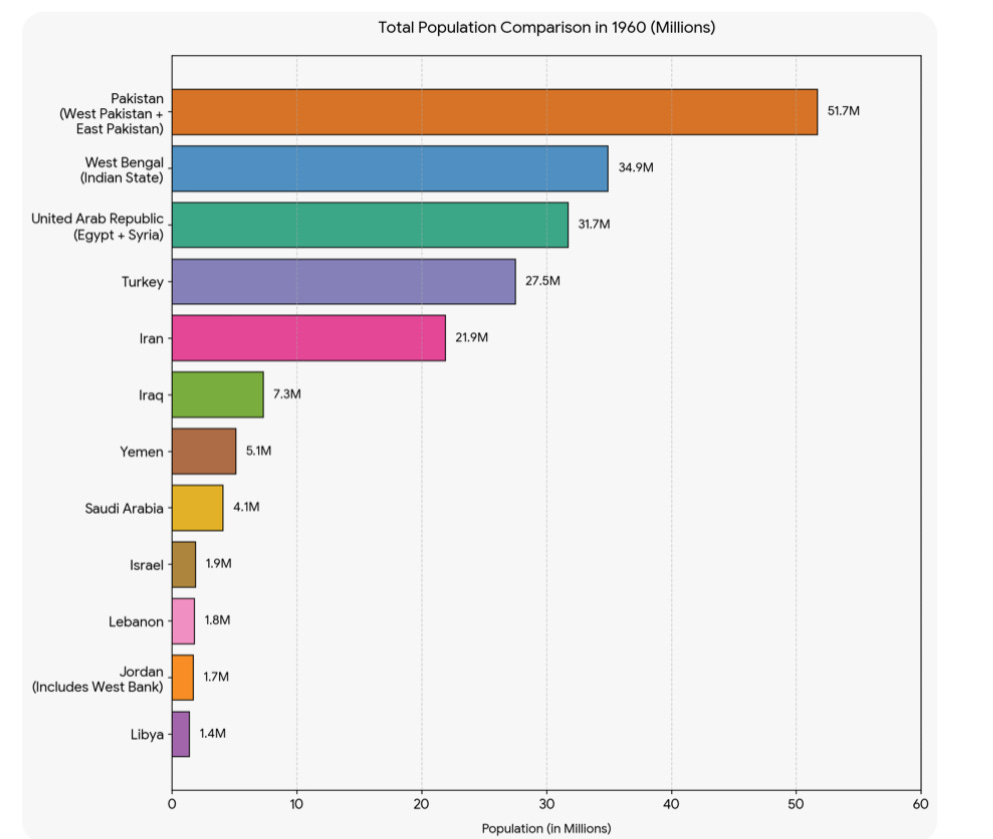
In 1970, just before Bangladesh became independent, Pakistan’s population was roughly 123 million, nearly as large as that of the entire Middle East or Arab world’s, and 35 times as large as Saudi Arabia’s. Today, even without Bangladesh’s 175-180 million people, Pakistan has approximately 260 million inhabitants, and is by far the largest fast-growing population in the world outside of Sub-Saharan Africa. The next largest fast-growing population outside of Africa is the Indian state of Bihar (northwest of Bangladesh) where fertility rates are relatively high both among the state’s 80+% Hindu majority and 18% Muslim minority. Bihar’s Muslim minority population numbers about 23 million, the same as the number of citizens in all of the Gulf Arab monarchies combined.
The 1972 Munich attack was a day before the anniversary of the quadruple plane hijackings of 1970. Not so unlike how Oct. 7 would later be a day after the 50th anniversary of the Yom Kippur invasion.
This took place closer in time to the Holocaust (27 years) than we now are to Schindler’s List
The Saudi king, Faisal (not related to the Faisals in Iraq), was later assassinated in 1975, by one of his nephews. (The king had hundreds, possibly thousands, of nephews). The nephew who killed him had gone to university in Berkeley from 1969-1973.
Unlike the Hashemites who were Sunnis (like Saddam Hussein) and foreign transplants, ruling over Iraq’s Shia Arab plurality, Qasim was of “mixed parentage, born to a Sunni Arab father and a Shia mother of Feyli Kurdish origin, reflecting the diversity of Karrada, where his family was based, and also having an influence on his political ideologies”, according to Wikipedia.
Compared to other Palestinian diasporas in the Gulf, Kuwait’s was by far the largest. Only Saudi Arabia’s, estimated at 250,000-275,000 in 1990, came close. Today, after waves of expulsions, approximately 55% of Palestinians live outside of Palestine/Israel (mainly in Jordan or other Arab states). About the same percentage of Jews live outside the region (mainly in New York or other American states). 50,000-100,000 Palestinians live in Kuwait today.
It's ironic that two countries (Russia and Ukraine) with rapidly shrinking populations should then start killing each other, especially if they are cousins