
Notes on Iran

I wrote a long article about Iran after the war in June 2025, which you can read here in full, or here for a much shorter version. Below are some of the footnotes1 from that article, mostly having to do with Supreme Leader Ali Khamenei or Iran’s relationships with the US, Gulf monarchies, and especially Israel.
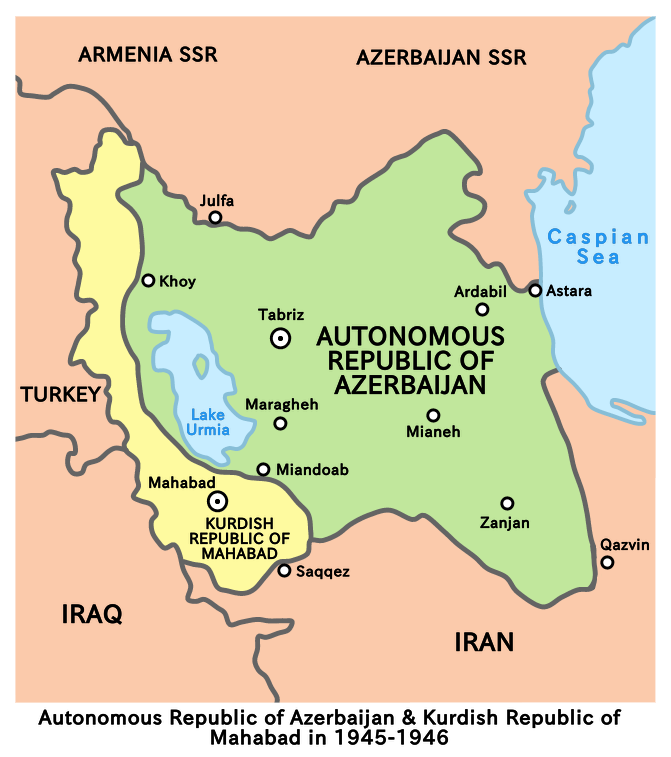
This spring will be the 80th anniversary of the 1946 Iran crisis, sometimes regarded as the first conflict in the Cold War. The Soviet Union had agreed to remove its soldiers from Iran on March 2, 1946, after having occupied the country along with the US and Britain during WWII. Instead of leaving, the Soviets propped up two small states they had created inside of north-western Iran, the Kurdish Republic of Mahabad and the Autonomous Republic of Azerbaijan. They also pressured Iran into granting them majority ownership of northern Iran’s oil sector. The Iranians annulled this oil deal a year later, with US backing. They reconquered their Azeri and Kurdish territories, at the cost of hundreds of Iranian soldiers’ lives. The leaders of these small states fled to the Soviet Union.
Seven years later, the Korean War, the first major war fought directly between the US and its Cold War rivals, causing millions of deaths, ended in a stalemate in July 1953 – only a few weeks before the infamous coup against Iranian prime minister Mohammad Mosadegh on August 19, orchestrated by the US and Britain. The coup was meant to undo the nationalisation of Iran’s oil, and crack down on Iran’s Soviet-aligned Tudeh party. A week before the coup, the first Soviet thermonuclear weapon (boosted fission) was detonated.
One day after the coup in Iran, on the eve of the Eid al-Adha holiday, France forced the sultan of Morocco, Mohammed V, into exile in Corsica, replacing him with his first cousin once removed. (In a somewhat similar manner, Britain and the Soviet Union put the Shah on the throne, when he was only 22 years old, in place of his father, after their joint invasion of Iran in 19412). Moroccan terror attacks led France to recall the exiled sultan a year later, who then negotiated with France and Spain to gain Morocco’s independence.
Around the same time, an Algerian protest in July 1953 in Paris was violently put down by the police, in the leadup to the Algerian war of independence against France, which began the following year. France also lost its war in Vietnam in 1954. Eisenhower’s domino theory speech, and the start of US aid to anti-Communist forces in Vietnam, was in August 1953 – again, the same month as the coup in Iran.
August 1953 also saw Ariel Sharon lead one of the first Israeli raids into Egyptian-controlled Gaza3, killing 20-30 Palestinians, before carrying out the Qibya massacre in the Jordanian-controlled West Bank in October. Egypt’s monarchy had been abolished two months earlier, after 1952’s Egyptian Revolution, led by officers Mohamed Naguib and Gamal Abdul Nasser. Nasser would then force Naguib out of power at the end of 1953, accusing him of supporting the Muslim Brotherhood and plotting to become a dictator. Nasser’s rise led in turn to the 1956 Suez Crisis, when, unlike in the Iranian coup, the US backed Nasser, restraining the British-French-Israeli invasion of Egypt.
In Jordan, Hussein began his 46-year rule as king in 1953, following his father’s abdication and his grandfather’s assassination by a Palestinian gunman at Jerusalem’s Al Aqsa Mosque in 1951. In Syria, military strongman Adib Shishkali was overthrown in February 1954, by Hashim al Attassi, who was backed in large part by Druze officers. (Shishkali was killed a decade later by a Druze assassin in Brazil).
In Israel, diplomatic relations with its former backer the Soviet Union were severed after a Jewish terror group bombed the Soviet embassy in Tel Aviv, one month before Stalin’s death in March 1953, in response to Stalin’s anti-Jewish Doctors’ Plot. In Saudi Arabia, the kingdom’s founder and decades-long ruler Abdulaziz Ibn Saud died in November 19534. Ibn Saud died a month after workers in the Shia-inhabited, oil-rich Eastern Province, at US-owned5 Saudi Aramco, began the country’s first significant labour strike.
A larger labour dispute, in East Germany in June 1953, turned into a mass uprising against the regime, the first to occur in Europe’s Communist bloc, leading to a violent crackdown by Soviet forces.
Three years later, the Soviet Union invaded Hungary in order to put down the Hungarian Revolution. This occurred during the same week that Israel, Britain, and France invaded Egypt. Part of the reason the US restrained that invasion may have been that they did not want to alienate Middle Eastern countries by appearing to be hypocritical, after having criticized the Red Army’s re-invasion of Hungary6 two days earlier. More than 700 Soviet soldiers were killed (among others) in crushing Hungary’s revolution, the most of any Soviet intervention between the Korean War and 1979’s Soviet invasion of Afghanistan.
In August 1988 the Iran-Iraq war finally ended. In February 1989, the day before the last Soviet troops left neighbouring Afghanistan in defeat, Khomeini issued his infamous fatwa against Salman Rushdie. (In 1990, The Satanic Verses’ Japanese translator Hitoshi Igarashi was stabbed to death as a result. In 1993 its Norwegian publisher survived being shot. In 2022 Rushdie survived being stabbed). In June 1989, Khomeini died. Ali Khamenei took over as Supreme Leader the next day. The same day that Khamenei took over, Attollah Byahmadi, an ex-colonel in the Shah’s intelligence service, was killed in Dubai, according to Radio Free Europe. Eleven days later, “Abdolrahman Qassemlou, leader of the largest of the Kurdish opposition groups, the Kurdish Democratic Party of Iran (KDPI), and two associates are assassinated in Vienna”.
The day of Khomeini’s death, June 3, 1989, was an eventful one at the end of the Cold War:
“On June 3-4, 1989, the Chinese government violently suppressed protests in and around Tiananmen Square, Beijing, with military forces using live ammunition and tanks to clear the area. This event resulted in a death toll estimated to be in the hundreds or thousands, though the exact number is disputed and officially suppressed by China…On June 4, 1989, Poles had their first free elections [since 1938]. The Polish Solidarity opposition won a landslide, capturing all but one contested seats in both the upper and lower houses of the parliament. This victory led to the appointment of the first non-communist prime minister and a unity government where former political dissidents sat together with their former oppressors. In this powersharing pact the government moved forward to dismantle the Polish communist system and initiate a peaceful democratic transition well before the Berlin Wall came tumbling down and the Soviet Union collapsed.”
Ali Khamenei first became Iran’s president on October 9, 1981. This was, coincidentally, three days after Egypt’s president Anwar Sadat was assassinated, on the eighth anniversary of the Yom Kippur War, for having made peace with Israel in 19797. Sadat had been a good friend of the Shah of Iran, who had died in Egypt the year before. The October 7th attacks in Israel in 2023 occurred one day after the Yom Kippur War’s 50th anniversary.
Because the Jewish calendar is lunisolar while the Islamic is lunar, it is often not realized that Yom Kippur and Ashura, the foremost Shia holiday, are historically the same holiday, both taking place on the 10th day (Ashura means ten) of the 1st month of their calendars. On Ashura Shia mourn the martyrdom of Muhammad’s grandson Husayn bin Ali, who is thought to have been killed at the Battle of Karbala in 680 AD8, along with his sons and 70 other companions. For Muslims in general, Ashura also marks the crossing of the Red Sea by Moses. After Israel’s 12-day war against Iran ended on June 24, 2025, Khamenei made his first public re-appearance on Ashura, on July 4.
Today the pilgrimage to Karbala in Iraq, which is held at the end of the 40 days of mourning that follow Ashura, is probably the largest annually held pilgrimage in the world, attracting approximately 20 million people per year. Jews by contrast observe 40 days of mourning leading up to Yom Kippur, beginning on the first day of the last month of the year. In Islam, the tenth day of the last month of the year is Eid al Adha, one of the year’s two main festivals (the other being at the end of Ramadan), commemorating the near-sacrifice and redemption of Ishmael by his father Abraham. Saddam Hussein, under whose rule public adherence of Ashura was largely banned, was executed on Eid al Adha in 20069. His trial, and the referendum on Iraq’s new constitution, were both held during Ramadan in 2005. (Iran’s final constitutional referendum was held on Ashura, during its 1979 Islamic revolution10). The current war on Iran, in 2026, has also been fought entirely during Ramadan, thus far.
During Khamenei’s first Ramadan as president of Iran, in 1982, “Operation Ramadan was an Iranian offensive in the Iran–Iraq War that consisted of three separate attacks that lasted for six weeks. It featured the use of human wave attacks in the largest land battle since World War II”.
In 1973, on the 10th of Ramadan, Egypt and Syria launched the invasion that began the Yom Kippur war, the deadliest of the four major Arab-Israeli wars and the worst day for Israelis until Oct. 7, 202311. It was a fast day for both sides in that war – as it was again in 2026. This time, religious Jews were observing the Fast of Esther12 on March 2, 2026, a day before the holiday of Purim. It commemorates the three days that Jews in ancient Persia fasted, before a Jewish queen (according to the Purim story) convinced the Persian king to save the Jews of the empire from destruction, and turn the tables on their enemies.
Three days before Husayn’s bin Ali’s martyrdom in Karbala – that is, on October 7, 680 AD13 – “on the orders of the Umayyad governor, the water supply to Husayn’s camp was cut off, marking the beginning of extreme thirst and hardship for his family and followers”.
In February 1994, on the day of Purim, the deadliest attack carried out by a Jewish terrorist since 194614 occurred, when Baruch Goldstein shot 29 Palestinians to death at Hebron’s Cave of the Patriarchs. Iran responded, a few hours later, by executing Feyzollah Mekhubad, a Jewish resident of Tehran, who had been in prison since 1992 on charges of being a spy for Israel. Itamar Ben Gvir, an open admirer of Goldstein – indeed, someone who has dressed up as Goldstein for Purim (which is a costume holiday), among other things – has been Israel’s Minister of National Security since 2022.
Goldstein’s attack was followed a year later by the assassination of prime minister Yitzchak Rabin, by another Jewish extremist who was against the Oslo Accords. Months after the assassination, Benjamin Netanyahu was elected prime minister for the first time, narrowly defeating Shimon Peres who was running as Rabin’s successor. Peres had been set to defeat Netanyahu, but a series of Hamas attacks in March and April 1996, just before the election in May, helped lead to a slight victory for Netanyahu’s coalition over Peres’.
One of these attacks, on March 4, 1996, came on the eve of the second Purim after Goldstein’s massacre, when a Hamas bomber blew himself up outside the Dizengoff shopping centre, the largest in Tel Aviv. According to Wikipedia, “The attack was the fourth suicide bombing in Israel in nine days, bringing the death toll during that span to over 60….These operations were, in their scale, scope and sophistication, different and larger than any attacks of the past, and it has been alleged that both Syria and Iran had helped in their planning and financing.” Hamas carried them out in response to Israel’s assassination of chief bombmaker and commander Yahya Ayyash in January 1996”. They were led by Mohammed Deif, who was killed last year in an airstrike which, at least according to the Gaza ministry of health, killed 90 Palestinians.
A month before the 1996 elections, Israel carried out a two-week military operation against Hezbollah in Lebanon, Operation Grapes of Wrath, in which an estimated 150-250 Lebanese were killed. Over 100 of those deaths occurred when Israel attacked a UN compound that was sheltering hundreds of Lebanese civilians, which Hezbollah fighters had retreated to during a fight with a commando unit led by Naftali Bennett. (Bennett was prime minister in 2021-2022, leading an anti-Netanyahu coalition that was the first in Israel’s history to formally include an Arab party. He might be re-elected again this year, representing religious Jews who are supportive of West Bank settlement, but who resent ultra-Orthodox not serving in the military while their own kids serve in large numbers). Many similar incidents to the 1996 UN attack occurred during the current war in Gaza.
Nearly all of the leaders in Iran who were targeted and killed by Israel during its recent 12-day-war were born in the early 1960s. Partly this is because they were in their early sixties when they were killed, and had therefore reached the age where they were in charge of the country’s military and intelligence organizations. But it is also because Iranians born in the early 1960s first reached military age when the Iran-Iraq War began in 1980, and rose through the ranks during those eight years of fighting.
Even the youngest targeted leaders came of age during the Iran-Iraq War. Abbas Nilforoushan, for example, an Iranian officer who died in Lebanon in 2024 in the same Israeli airstrike that killed Hezbollah leader Hassan Nasrallah, was born in 1966. Yet he still joined Iran’s paramilitary Basij at 14 years old when the Iran-Iraq war began, and was an officer by its end. Similarly, Khamenei’s eldest sons, born in 1965 and 1969, both served in the war.
Ali Khamenei, by contrast, was already in his forties during the Iran-Iraq War (as was Saddam Hussein). In 2026 he was 86 years old, the same age as his predecessor Ruhollah Khomeini when Khomeini died in 1989, soon after the war ended. Khamenei was Supreme Leader for more than 36 years, longer than any current leader of a major country. He was months shy of the Shah’s 37-year-rule, prior to the Shah’s abdication in 1979.
Khamenei was the Islamic Republic’s third president during the Iran-Iraq war, before becoming Supreme Leader. His predecessor as president, Mohammad-Ali Rajai, was assassinated in 1981, allegedly by the left-wing People’s Mojahedin Organization of Iran (MEK). Rajai’s assasination took place two weeks after a bombing that killed over seventy Iranian officials, including the Chief Justice, Mohammad Beheshti, thought to be the regime’s second highest ranking leader behind Khomeini. The day before the bombing, Khamenei had been badly injured in an assassination attempt. Five days before that, the Islamic Republic’s first president, Abdolhassan Banisadr, was impeached, charged with treason, and fled the country. He died of old age in France in 2021.
Iran’s prime minister was also killed in the same assassination that killed Iran’s president in 1981, eleven months into the Iran-Iraq war. He was succeeded by Mir-Houssein Mousavi, who served as prime minister for the remainder of the war, during the same years that Khamenei was president. Mousavi was Khamenei’s first cousin once removed15, but they were often rivals. When Khamenei took over Khomeini’s role as Supreme Leader in 1989, Mousavi was pushed out of politics for several years and there has been no Iranian prime minister since. (The first prime minister appointed during the Iranian Revolution, Shapour Bakhtiar, was assassinated in exile near Paris soon afterwards, in 1991). Mousavi has been under house arrest since 2011.
The other leader from Khamenei’s generation is former president Akbar Hashemi Rafsanjani, who died in his swimming pool in 2017 at 82 years old. (President Rouhani ordered an investigation into the death, while Rafsanjani’s family claims he was poisoned). Mousavi, after serving as prime minister from 1981-1989, ran against Ahmadinejad for president in 2009. He is now considered a leader of the Green Movement, which was prompted by protests following that election. Mousavi’s nephew was shot and killed during those protests. Rafsanjani was president from 1989-1997, succeeding Khamenei in that role; he later lost the 2005 presidential election to Ahmadinejad. A year before his death, Rafsanjani attempted to run again for president, but was banned from doing so on the pretense that he was too old.
After being invaded at the start of the Iran-Iraq War, by the middle of 1982 Iran regained nearly all the territory it had lost. (In the spring of 1982, Khamenei stated that Khomeini should be the Supreme Leader of Iran and Iraq). Soon after, in Lebanon, a number of key events occurred that pertain to the ongoing conflicts involving Iran and other countries in the region. These include the Israeli invasion of Lebanon in June 1982, the Sabra-Shatila massacres in the fall of 1982, the Beirut barracks bombings in 1983 and US embassy bombings in 1983 and 1984, and the 1983-1988 pro-Iran terror attacks on Kuwait16.
The Sabra and Shatila massacres took place two days after the assassination of newly elected Lebanese President Bachir Pierre Gemayel, a Christian. The massacres involved the killing of several hundred or several thousand civilians, mostly Palestinian refugees or Shia Lebanese, by a Christian Lebanese militia, backed by Israeli forces that were surrounding the area, in the neighbourhood of Sabra and refugee camp Shatila.
The following year, Israel’s Kahan Commission deemed that Israeli Defence Minister Ariel Sharon, among others, bore personal responsibility for the massacres. “Initially, Sharon refused to resign, and Prime Minister Menachem Begin refused to fire him. However, following a peace march against the government, as the marchers were dispersing, a grenade was thrown into the crowd, killing a reserve combat officer and peace activist, and wounding half a dozen others, including the son of the Interior Minister. Although Sharon resigned as Defence Minister, he remained in the Cabinet as a Minister without Portfolio. Years later, Sharon would be elected Israel’s Prime Minister [in 2001].”
In 2002, one of President Gemayel’s closest associates, militia commander and politician Elie Hobeika, who had been involved in carrying out the Sabra and Shatila massacres, was assassinated by a car bomb in Beirut, not long before he was scheduled to testify in a Belgian court about the massacres. Hobeika’s fiancee and much of his family had been killed in an earlier massacre, the Damour massacre, perpetrated by a Palestinian militia in 1976; which was itself a response to still earlier massacres of Palestinians. Syrian forces, which had occupied Lebanon since 1976, left in 2005, soon after the assassination of Lebanon’s prime minister Rafic Hariri17, a Sunni, by members of Hezbollah, which then fought its first major war with Israel the following year.
In March 2001, Ariel Sharon appointed the extremist politician Rehavam Ze’evi to be his Tourism Minister in his cabinet. Ze’evi was not as extreme as Netanyahu’s current national security minister Itamar Ben Gvir or finance minister Bezalel Smotrich are, nor was he given as important a ministry as they have been given, but he was not so far off18. Ze’evi was assassinated by Palestinian gunmen on October 17 2001, only two days after he had resigned from Sharon’s government in protest of Sharon’s withdrawal of Israel’s soldiers from areas of Hebron (where, among many other things, Ben Gvir now lives). This was during a period of intense Israeli-Palestinian violence, and strained US-Israeli relations, during the Second Intifada and around the beginning of the US war in Afghanistan on October 7. In some ways it was a precursor to Sharon angering Israel’s right-wing by dismantling Israel’s settlements within Gaza in 2005, which was followed by Hamas’ takeover of the strip in 2007.
While Israel and Iran were increasingly becoming enemies in Lebanon in the early 1980s, their pre-1979 alliance remained partially intact in spite of Iran’s anti-Zionist rhetoric, support for the emergence of Hezbollah, and exodus of tens of thousands of Iranian Jews. In 1980 during the second week of the Iran-Iraq war, Israel helped Iran’s air force attack Iraq’s Osirak nuclear reactor. In 1981 Israel carried out its own attack on Iraq, destroying the reactor. And during the mid-1980s Israel participated in the Iran-Contra affair, selling Iran weapons.
After Saddam Hussein’s Iraq, a common enemy of Iran and Israel, was weakened in the First Gulf War, relations between Israel and Iran worsened. In 1992, “The attack on the Israeli embassy in Buenos Aires was a suicide bombing attack on the building of the Israeli embassy of Argentina, located in Buenos Aires. 29 civilians were killed in the attack and 242 additional civilians were injured. A group called Islamic Jihad Organization, which has been linked to Iran and possibly Hezbollah, claimed responsibility; their stated motive for the attack was Israel’s assassination of Hezbollah Secretary-General Sayed Abbas al-Musawi in February 1992.”
In July 1994, a suicide truck bombing of the Jewish community centre in Buenos Aires killed 85 people, the attack carried out by Hezbollah operatives. One day later a Hezbollah-suspected suicide bombing on a Panamanian airplane killed all 21 passengers, 12 of whom were Jews. A week after that – and one day after Israel and Jordan signed the Washington Declaration, in anticipation of their peace treaty in October 1994, which made Jordan the second Arab country to officially recognize Israel, after Egypt – the Israeli embassy in London was car-bombed, followed hours later by a similar car bomb exploded outside a Jewish community centre in London. Nobody was killed in the London bombings.
Natalio Alberto Nisman, the special prosecutor in charge of the 1994 Buenos Aires Jewish community centre bombing investigation, was murdered in 2015, when the investigation was (even after two decades) still ongoing:
“The 2013 signing of a memorandum of understanding with Iran to facilitate the investigation led to a breach between Nisman and President Cristina Fernandez de Kirchner”, according to Wikipedia. “Nisman’s death was initially ruled a suicide by a group of forensic experts appointed by Argentina’s Supreme Court in 2015…In December 2017, Cristina Kirchner was indicted for treason by judge Claudio Bonadio. In March 2018, it was announced that she would be put on trial for an alleged cover-up of Iran’s role in the bombing... After analyzing the claims of the defendants in the case for the never-ratified Memorandum with Iran, on October 7, 2021, the Federal Oral Court 8 declared the case null and void”.
On the 30th anniversary of the terror attack in 2024, Argentina’s new president Javier Milei announced that investigations would be reopened.
1979, the year of the Iranian Revolution, was the year in which Israel first attempted to prevent a rival country, Iraq, from developing nuclear power. In April, in southern France, Israeli agents used explosives to sabotage a reactor that was about to be shipped to Iraq. A little over a year later, in Paris, they assassinated an Egyptian scientist who was leading Iraq’s nuclear programme. Finally, Israel attacked the Iraqi reactor directly in 1981.
Iran too carried out a significant assassination in Paris in December 1979, killing Shahriar Shafiq, a son of the Shah’s twin sister. Shafiq had been the highest-ranking royal in the Iran military, and the last to leave Iran during the revolution. In Paris in 1980, the Iranians also attempted to kill Shapour Bakhtiar, the last pre-revolutionary prime minister of Iran. He had been an opponent both of the Shah’s regime and of Khomeini. That attempt was a failure, but they later did assassinate him in Paris in 1991.
The assassination of Supreme Leader Khamenei in the current war, and the likelihood of Khamenei’s son Motjaba now being targeted as well, arguably raises the question of what might occur if Iran or its allies were to kill Saudi Arabia’s Crown Prince, Mohammed bin Salman.
Would MBS’ assassination lead to a succession crisis in Saudi Arabia? His father, King Salman, is 90 years old, and there is currently no deputy crown prince. One of MBS’ younger brothers, Khalid, is minister of defense, a job held by MBS from 2015-2022 and by Salman from 2011 until he became king in 2015. The former crown princes, Muqrin (the youngest living son of Salman’s father, the kingdom’s founder Abudlaziz Ibn Saud) and Mohammed bin Nayef (the son of one of Salman’s six full-brothers), are 81 years old and 66 years old, respectively; but MBN was only crown prince for three months before MBS took over that role in 2017, and he is now living in confinement, having been arrested, and allegedly tortured, in 202019. Salman’s only living full-brother, Prince Ahmed, who is 84 years old, was also charged with treason in 2020.
In July 1987, an estimated 400 people died during a riot at the Haj in Mecca between Shia Iranian and Sunni pilgrims, one of the low points for Iran-Saudi relations.
In June 1996, the Khobar Towers truck bombing on the Gulf coast of Saudi Arabia, near the headquarters of oil giant Saudi Aramco, killed 19 US air force personnel and wounded hundreds of people from many countries. Iran was thought to be behind the attack, although it is not known for certain. It may be that the Saudis blamed Iran rather than admit they were facing a domestic terrorism threat. “William Perry, who was the US Secretary of Defense at the time, said in an interview in June 2007 that “he now believes al-Qaida rather than Iran was behind a 1996 truck bombing at an American military base.”
In the late 1990s, a partial realignment of Iranian and American interests took place20, as Sunni forces such as the Taliban and al Qaeda were on the rise, while Saddam Hussein’s Iraq was moving sharply away from its secularist Ba’athist roots towards its own brand of Sunni-led religious extremism. The Taliban conquered Kabul in 1996, and then, after conquering Mazar-i-Sharif (Afghanistan’s fifth largest city) on August 8, 1998, killed 11 Iranians in an attack on Iran’s consulate, and also killed thousands of Shia Afghans and Tajik (Persian)-speakers, nearly leading to a war between Iran and the Taliban.
Coincidentally, one day earlier, al Qaeda carried out its first major attack, the US embassy bombings in Tanzania and Kenya, killing 224 people, including 12 Americans, and wounding over 400021. Two days before the embassy attacks – again, coincidentally – Iraq suspended cooperation with UN weapons inspectors. The US responded by passing the Iraq Liberation Act of 1998, which supported the overthrow of Saddam Hussein, and then by bombing Iraq at the end of the year. The US also, on August 20, tried to retaliate against al Qaeda, bombing the al-Shifa pharmaceutical factory in Sudan and a camp in Afghanistan.
The twin events of Aug 7-8, 1998 would have an echo three years later, when al Qaeda assassinated Afghanistan’s leading Tajik figure, Iran and India’s ally Ahmad Shah Massoud, two days before September 11, 2001.
Meanwhile, in the Iraqi Kurdish civil war (1994-1998), Iran switched sides in 1995, going from supporting the KDP, which was backed by Baghdad, to the PUK, which was favoured by the US. More generally, there was a thaw in relations, and quiet cooperation, between Iran and the US, until they became direct rivals of one another in post-Saddam Iraq and the Middle East at large after 2003.
Protests occurred in Iran’s oil-rich, Arab-inhabited province of Khuzestan in April 2011, during the Arab Spring and on the anniversary of the province’s 2005 unrest. The Arab Spring in general impacted Iran in a number of ways. First, it risked spreading into Iran, not just via Khuzestan but also through unrest in the country at large, which was already in the middle of its Green Movement protests. Second, it led to the Syrian civil war, in which Bashar al Assad was forced to rely on support from Iran, Hezbollah, and Russia. It also caused the ouster of President Saleh in Yemen, which became an Iranian-Saudi proxy war, eventually leading to Saudi and Emirati military intervention in 2015. Finally, it led Saudi Arabia and the UAE to send forces to Bahrain – an island claimed by Iran until 1971 – in order to assist Bahrain’s Sunni monarchy against protestors from its Shia majority.
According to the Washington Institute, the Bahraini intervention by Saudi Arabia during the Arab Spring may have contributed to the failed Iranian plot to assassinate the Saudi ambassador at a restaurant in Washington and then bomb both the Saudi and Israeli embassies22.
The other news in Iran this year has been the deportation of nearly one million Afghan refugees and migrant workers, which had been taking place in the months before Israel and America’s airstrikes and has reportedly intensified since. A similar process has been occurring in Pakistan.
According to Hessam Habibi Doroh, a researcher at Khayrion, “The Afghan migrant community in Iran is estimated at 5-8 million individuals, which amounts to roughly 5.5-8.7% of the total population of c. 92 million. About 2.7 million of these 5-8 million individuals are registered, a bit less than half. Factors such as shared cultural ties, language and the Shi’a identity of the Hazara community, coupled with a relatively open 900-km border, have historically facilitated Afghan migration, while Iran has also tended to function as a transit hub for Afghan migration to Turkey and Europe…Iranian authorities intensified their rhetoric against undocumented Afghan migrants with calls for tougher migration policies and facilitation of forced returns. This sentiment also resonated in political discourse with high-ranking officials such as Parliament Speaker Mohammad Baqer Qalibaf advocating for the construction of a border wall and the closure of Iran’s eastern border, a stance that became a central issue in the 2024 presidential campaign.”
According to the New York Times: “Since March, when Iranian authorities ordered undocumented residents to leave the country, about 800,000 Afghans have poured across the border, Babar Baloch, a spokesman for the United Nations’ refugee agency, said on Monday. Almost 600,000 of them have been forced out since June 1.
During and since the 12-day war between Israel and Iran in June, Iranian officials have repeatedly cast suspicion on Afghans as possible spies for Israel, amplifying longstanding rumors and tensions…Iran has ranked as the world’s biggest host country for refugees, with nearly 3.5 million according to the United Nations, primarily people who fled decades of war and violence in Afghanistan. Aid groups estimate that in reality, the Afghan population in Iran is much larger — including about two million refugees who are undocumented — and Iran’s patience with them appears to have run out.”
According to the Diplomat, “Iran is not acting alone. Since late 2023, Pakistan has intensified its deportation campaign against Afghan nationals. In April alone, more than 135,000 Afghans left Pakistan, followed by approximately 67,000 in May. Pakistan’s “Illegal Foreigners Repatriation Plan” targets undocumented migrants, including long-term resident Afghans and those awaiting resettlement…Turkiye [too] has continued to operate removal centers and conduct charter deportation flights to Kabul throughout 2024. In parallel, it has continued pushbacks along its eastern border with Iran, where Afghan migrants attempting to enter Turkish territory are being systematically forced back.”
On February 21, 2026, one week before the US and Israel attacked Iran, Pakistan and Afghanistan went to war against one another. More than a thousand people have been killed in that other war, which is still ongoing. It began at the end of a period of increased terror attacks within Pakistan; notably, on Feb 6, there was a suicide bombing in Islamabad that was the deadliest in Pakistan’s capital since 2008. There were also several attacks from Baluchistan23, the mountainous region that spans the borders between Iran, Pakistan, and Afghanistan.
The even more contentious border zone between Pakistan and Afghanistan is the Pashtun region. In Afghanistan, Pashtun are perhaps half the country’s population, and have generally been the driving force behind the Taliban. In Pakistan Pashtun are even more numerous, but because Pakistan’s total population is so large, the Pashtun are only maybe 15% or so of the country’s inhabitants, much lesser in number than Pakistan’s Punjabis. Afghanistan has therefore often laid claim to the rugged Pashtun-inhabited areas of Pakistan that are located just across the Afghanistan-Pakistan border. The Afghan Taliban, despite long being allies of Pakistan (to one degree or another), are no different in viewing the border as an artificial construct, first created by Britain.
Two weeks after the coup against Mossadegh in Iran in 1953 (to come full circle here), Mohammad Daoud Khan became prime minister of Afghanistan, replacing his aging uncle. Khan was a cousin of the Afghan king at the time, and also married to the king’s sister24. As prime minister, Daoud led a Pashtunization25 policy in the country and within its armed forces, leading to tensions with Pakistan (which had only been created six years earlier) and therefore to a closer relationship to the Soviet Union rather than to Pakistan’s Anglo allies.
In 1973, a few months before the Yom Kippur War26 and the first oil price spike, Daoud overthrew his brother-in-law the king, turning Afghanistan into a republic, with himself as president. In 1975, Pakistan supported the Panjshir uprising against Daoud, led by a young Tajik Afghan, Ahmad Shah Massoud27 (born 1953, killed on September 9, 2001 by Al Qaeda, in preparation for the coming war). The uprising helped convince Daoud to mend ties with Pakistan, distance Afghanistan from the Soviet Union and move instead toward a closer relationship with the newly oil-rich American allies in the Gulf, including Iran.
On a 1978 visit to Pakistan, Daoud “agreed to stop supporting anti-Pakistan militants and to expel any remaining militants in Afghanistan.” Months later, the Soviets helped support a coup against him, by members of the Communist People’s Democratic Party of Afghanistan. Daoud, his wife, brother, children, and grandchildren were killed. That was the Saur Revolution, the year before the Iranian Revolution and Soviet invasion of Afghanistan.
Whereas Iran’s revolution in 1979 removed a dynasty that was only 54 years old, Daoud’s family had been in power for roughly 155 years before Afghanistan’s revolution in 1978.
Finally, here are a few excerpts from Alex Vatanka’s excellent book The Battle of the Ayatollahs in Iran, which covers Iranian politics since 1979 through the lens of the relationship between Khamenei and Rafsanjani:
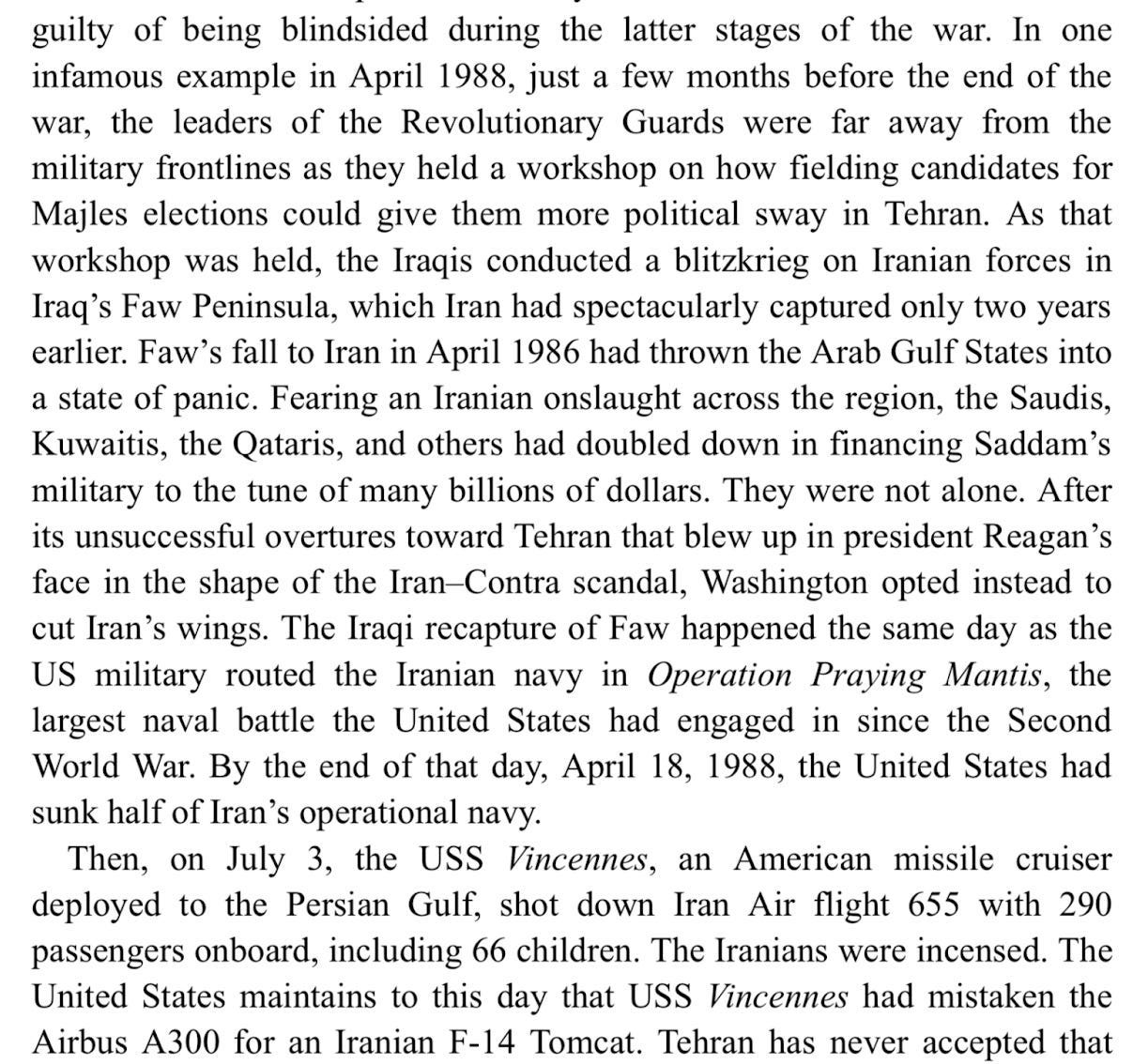
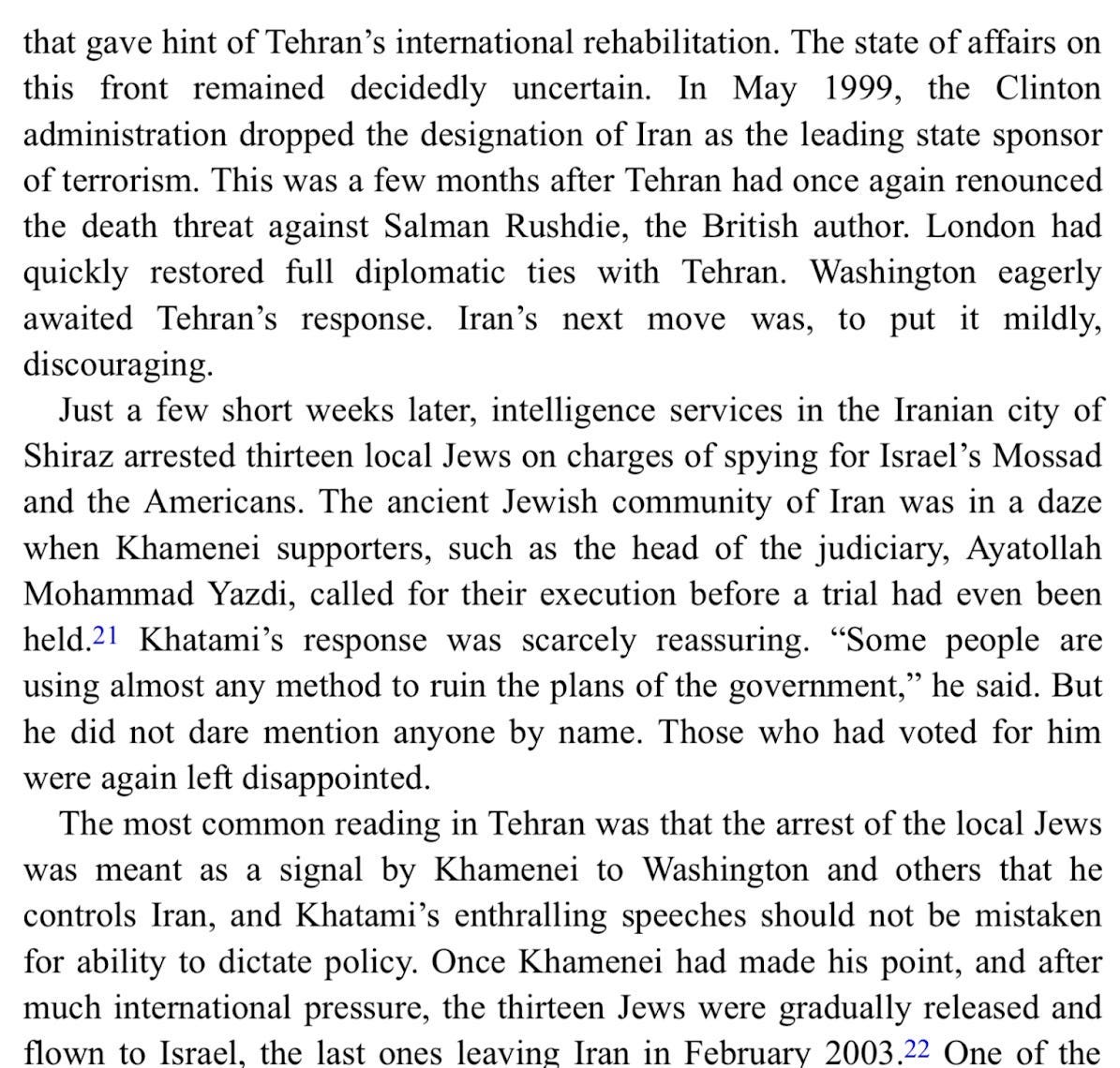
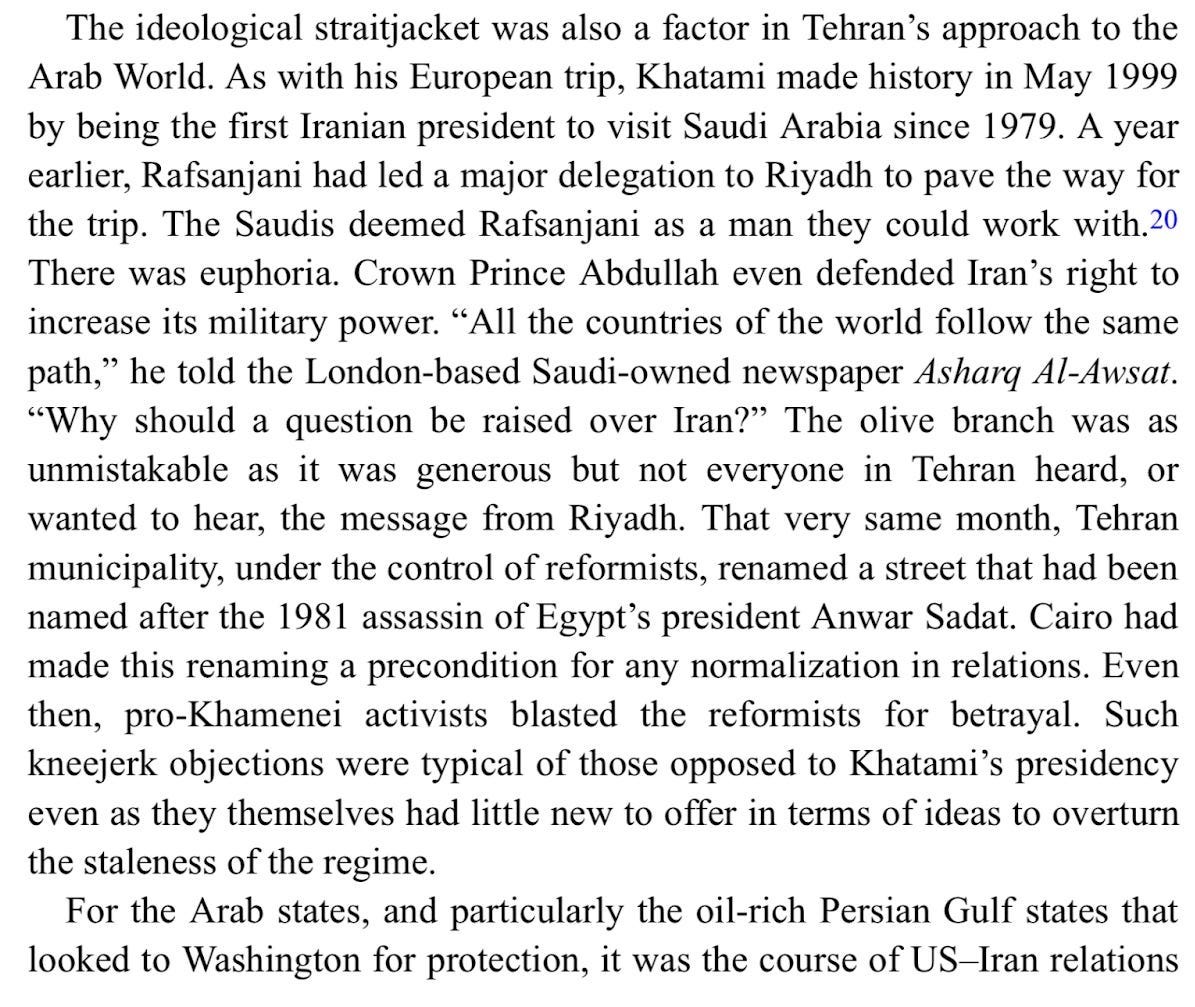
Mostly. Some additions, edits, and rearrangements have also been made.
This was on Sept 16 1941, three months after the Nazi invasion of the Soviet Union began and three months before the Japanese attack on Pearl Harbor. It was two days before the Nazi conquest of Kiev. The Allies ousted Reza Pahlavi, who had become Shah in 1925 with British backing, after overthrowing the Qajar dynasty that had ruled since 1789. His 22-year old son Mohammad Reza Pahlavi was placed on the throne instead, where he would stay until 1979.
Wikipedia: “The first insurrection by Palestinian fedayeen may have been launched from Syrian territory in 1951, though most attacks between 1951 and 1953 were launched from Jordanian territory..In 1953, Israeli Prime Minister David Ben-Gurion tasked Ariel Sharon, then security chief of the Northern Region, with setting up a new commando unit, Unit 101, designed to respond to fedayeen infiltrations. In August, after one month of training, “a patrol of the unit that infiltrated into the Gaza Strip as an exercise encountered Palestinians in al-Bureij refugee camp, opened fire to rescue itself and left behind about 30 killed Arabs and dozens of wounded.” In its five-month existence, Unit 101 was also responsible for carrying out the Qibya massacre on the night of 14–15 October 1953 in the Jordanian village of the same name. Cross-border operations by Israel were conducted in both Egypt and Jordan “to ‘teach’ the Arab leaders that the Israeli government saw them as responsible for these activities, even if they had not directly conducted them”.
One of Ibn Saud’s sons, Salman, was made deputy governor of Riyadh in 1953, at 18 years old. He would later become governor of Riyadh for 48 years, before being made Saudi Arabia’s defense minister in 2011 and king in 2015.
Until 1974, when the Saudis gained majority ownership of the oil giant.
Two events in 1953-1954, related to one another as well as to both Hungary and Israel, were the Kastner affair and the Ma’agan disaster.
A month after Ayatollah Ruhollah Khomeini’s triumphant return to Iran during its revolution.
In 614 AD, when Husayn’s father Ali (later Muhammad’s son-in-law; Shia is short for ‘supporters of Ali’) was only about 14 years old, before the establishment of the first Muslim community (in Medina), the Persians conquered Jerusalem from the Byzantines, aided by local Jewish forces led by Nehemiah ben Hushiel. The Persians are thought to have then granted autonomy to the Jews in Jerusalem, which lasted for about three years before it reverted to Christian control, the last time before the 20th century that this occurred.
Nehemiah shared the same name as the biblical Nehemiah a millennium earlier, cupbearer to the Persian emperor Artaxerxes, who was appointed governor of Judea to rebuild the city’s walls around 440 BC, a generation after Jerusalem’s Second Temple had been built with the support of the Persian empire. Many scholars also believe the Book of Esther was written around this time, between 460-350 BC.
Not to get too lost in these holiday parallels and coincidences, but there are actually two Jewish new years’, the biblical new year which begins in spring just before Passover, and the extra-biblical Rosh Hashanah that precedes Yom Kippur. This current war in 2026 began hours after the 10th day of the last month of the biblical calendar; which, in the Islamic calendar, corresponds to Eid al Adha.
On Ashura in 1979, the Muharram Intifada, an uprising in Saudi Arabia’s Shia-inhabited oil-rich Eastern Province, began. This took place during the siege of the Grand Mosque of Mecca that had begun ten days earlier, on the first day of the 1400th year of the Islamic calendar.
To this day, there is a satellite city of Cairo named 10th of Ramadan City, and another named 6th of October City. Egypt’s Armed Forces Day is celebrated annually on October 6.
One of six fast days of the Jewish calendar.
Wikipedia: “While October 10 is the widely accepted date for the battle of Karbala, some scholars note that conversions from the tabular Islamic calendar to the Gregorian calendar can produce a slight margin of error (plus or minus one or two days) due to differences in moon sightings. However, the date is firm in terms of the 10th of Muharram, 61 AH.”
The deadliest Jewish terror attack was the King David Hotel bombing in July 1946, carried out by Menachem Begin’s Irgun. It killed 91 people. The hotel bombing led the British to pursue the Morrison-Grady plan a month later, a joint US-British proposal to divide British Palestine into multiple autonomous zones under British governance. Pressure from Jews in New York ahead of a mid-term election then led President Truman to renounce this plan, announcing on Yom Kippur that he favoured the creation of “a viable Jewish state”. Hours after the Yom Kippur fast ended, on October 5-6, Jews in Palestine moved to create “11 points in the Negev”, quickly creating settlements in an attempt to ensure that the Negev would not become part of an Arab state at the time of the coming partition. Years later, on Oct. 7, 2023, several of these 11 settlements became the primary victims of Hamas’ surprise attack, including Kibbutz Be’eri.
Mousavi was from Iran’s large Azeri Turk minority, as was Khamenei on his father’s side. Iran’s current president Masoud Pezeshkian is Azeri too. The population of Azeri Turks in Iran is larger than that of Azeris in Azerbaijan, Arab citizens of Saudi Arabia, or Jews in the world.
In neighbouring Bahrain, just off the coast of the Saudi Eastern Province’s capital city and major oil fields, Iran supported a coup attempt by the Islamic Front for the Liberation of Bahrain in 1981. Iran had long claimed Bahrain as a historical province of Iran, and Bahrain’s small population – only 350,000 in 1979 – was largely Shia, but ruled over by a Sunni monarchy. The coup attempted to place an Iraqi Shia ayatollah who was exiled in Iran, Hadi al Modarresi, in power in Bahrain.
After twice being PM in the 2010s, and retiring in 2022, Hariri’s son Saad announced that he might be returning to Lebanese politics a few weeks ago, on the anniversary of his father’s assassination, ahead of scheduled elections (which may now be postponed, due to war) in May.
In 1988, Ze’evi established the Moledet (Homeland) party advocating the population transfer of Arabs from the West Bank and the Gaza Strip to the neighboring Arab countries. In the election of that year, he won a seat in the Knesset which he held until his death….A report in 2016 from a television news magazine aired allegations that Ze’evi killed unarmed Bedouins, conspired in an attempted murder of a reporter, and raped a soldier under his command. The publication drew calls for an end to government funding for programs honoring Ze’evi... In a radio interview in July 2001, Ze’evi stated that 180,000 Palestinians worked and lived illegally in Israel. He described them as a “cancer” and said Israel should rid itself of those who were not Israeli citizens “the same way you get rid of lice.] He called for denying the vote to Arab citizens who did not serve in the army…One of Ze’evi’s closest friends was the Muslim Israeli-Arab officer and war hero Amos Yarkoni. Ze’evi and Yarkoni had worked together in the IDF. After Yarkoni’s death Ze’evi loudly criticised the decision not to bury him in a military cemetery for halakhic reasons”… A few days after the Six-Day War in 1967, Ze’evi submitted a plan for the creation of a Palestinian state called the State of Ishmael, with Nablus as its capital. He urged Israel’s leaders to establish this state as soon as possible, claiming that “Protracted Israeli military rule will expand the hate and the abyss between the residents of the West Bank and Israel, due to the objective steps that will have to be taken in order to ensure order and security.”
Prince Turki, one of the sons of Salman’s predecessor King Abullah, is also in detention now, after having been governor of Riyadh, the job that Salman had for nearly five decades before becoming king.
The partial thaw in Iranian relations with the West (and its Arab allies) in the late 1990s overlapped with the coming of age of Iran’s largest generation, those who were born around the time of the Iranian revolution. This coincided with the presidency of Mohammad Khatami (1997-2005), and Iran’s student protests in 1999. Khatami is now 82 years old; in Jan 2025, “President Masoud Pezeshkian voiced his opposition to restrictions placed on the public appearances of former President Mohammad Khatami, the unofficial leader of the Reform Front”.
This was also only a few weeks after the foiled 1998 World Cup Plot would have occurred. It was also not too long before the USS Cole bombing, an attack generally thought to be carried out by Al Qaeda, but which Trump blamed Iran for it in the announcement he made just after killing Khamenei.
According to the Washington Institute: “The deployment of Bahraini Defense Force tanks, backed by Saudi Arabian and UAE forces, caused shock and anger among Bahraini Shi`a and among the Shi`a leadership and people of Iran and of Iraq. There is some indication that the Iranian leaders regretted not being in a position to support the Bahraini Shi`a in what might have been a decisive political action against the Sunni monarchy. It was reportedly right after the 2011 protests that Arbabsiar [one of the two Iranian nationals charged in the assassination plot] presented himself to his cousin, a senior Quds Force official, and that the Quds Force began planning the assassination of the Saudi ambassador, Adel al-Jubeir. Gholam Shakuri, the IRGC-Quds Force officer identified by one of the plotters as being in charge of the operation, is believed by Saudi intelligence to have met with a radical Bahraini Shi`a cleric in Beirut in early 2011 before the operation began.
Balochis have been involved in significant attacks in recent years. According to Chatham House, in Pakistan, in March 2025, “Baloch separatists hijacked a passenger train carrying more than 400 people travelling from Quetta to Peshawar…Responsibility for the attack was claimed by the militant Baloch Liberation Army (BLA). The subsequent siege, near the Bolan Pass in a remote part of Pakistan’s southwestern province of Balochistan ended – apparently without mass casualties – after a 36-hour stand-off between the hijackers and army special forces. But some lives were lost. According to Pakistani military sources, at least 31 people, including civilians and security personnel, as well as 33 militants, were killed in the action. However, the BLA has disputed these figures claiming that it took 214 hostages and killed them all.”
Iran’s political leaders have lately been discussing a grand, unlikely plan to move the country’s capital away from Tehran, to the opposite end of the country along southeast Iran’s desert sea coast. This plan is made only slightly plausible as a result of rapidly falling desalination costs, but it remains far-fetched all the same. One reason (of many) it is unlikely is the threat from Balochi militants.
“In 2024, Iran carried out a series of missile and drone strikes within Pakistan’s Balochistan province, claiming that it had targeted the Iranian Baloch Sunni militant group Jaysh al-Adl. The incident occurred one day after Iran carried out a similar series of aerial and drone strikes within Iraq and Syria, claiming that it had targeted the regional headquarters of the Israeli intelligence agency Mossad within Iraqi semi-autonomous Kurdish region and several strongholds of terrorist groups, in Taltita, Syria, in response to the Kerman bombings on 3 January, for which the Islamic State took responsibility and December 2023 killing of IRGC general Seyed Razi Mousavi.”
Daoud married the king’s sister in 1934, a year after the assassination of the previous king, Mohammad Nadir Shah, and of the king’s brother in Nazi Berlin a few months before that. Nadir Shah had come to power in 1929, after a civil war was sparked by his predecessor, Amanullah Shah, refusing to relinquish claims to the Pashtun areas of British-ruled India. Amanullah had himself become emir, then king, after the assassination of his father in 1918 – allegedly on Amanullah’s orders. His father Habibullah was killed for being too close to the British, who were fighting the Islamic Ottoman empire in WWI. Amanullah then led a coup against his father’s brother and went to war with Britain, the Third Afghan War of 1919. This took place at the same time as the British were facing a growing independence movement in India – the infamous Amritsar massacre was in April 1919, in the nearby Punjab - while also being involved in the Russian civil war in Central Asia. Britain “recognized Afghanistan’s status as a sovereign and independent state the following year”. After Amanullah was forced out by Nadir Shah in 1929, he went into exile in Fascist Italy, and died in Switzerland in 1960.
Wikipedia: “During his time as prime minister and president, Khan was highly unpopular among the non-Pashtun minorities in Afghanistan because of his alleged Pashtun favouritism. During his regime, all significant positions in the government, army and educational institutions were held by Pashtuns. His attempt at the Pashtunisation of Afghanistan reached such an extent that the word ‘Afghan’ started being used to refer only to Pashtuns and not to the other minority groups who collectively formed a majority in Afghanistan.]The Afghan Armed Forces were allied with Daoud Khan and supported his goal of promoting Pashtuns to higher posts in the Afghan Armed Forces. In 1963, Afghan Uzbeks were barred from becoming high-ranking officers in the Afghan armed forces. Similarly only a few Tajiks were allowed to hold the position of officer in the Afghan army, while other ethnicities were excluded from those positions, despite making up more than 50% of the Royal Afghan Army’s personnel”.
“On October 1, 1973, Mohammad Hashim Maiwandwal, the former Prime Minister of Afghanistan (1965–1967), died in a Kabul prison, after having been arrested in September for his alleged involvement in a counter-coup plot against the regime of Daoud Khan, who had seized power just months earlier”.
“Infuriated by the arrogance of his communist peers and Russian professors, a physical altercation between Massoud and his Russian professor led Massoud to walk out of the university, and shortly after, Kabul. Two days later, Massoud and a number of fellow militant students traveled to Pakistan where, goaded by another trainee of the Pakistani Inter-Services Intelligence (ISI), Gulbuddin Hekmatyar, Massoud agreed to take part in a coup against Daoud with his forces rising up in the Panjshir and Hekmatyar’s elsewhere.In July 1975, Massoud, with help from the Pakistani intelligence, led the first rebellion of Panjshir residents against the government of Daoud Khan. While the uprising in the Panjshir began saw initial success, even taking the military garrison in Rokha, the promised support from Kabul never came and the rebellion was suppressed by the 444th Commando Battalion sending Massoud back into Pakistan where he would attend a secret, paramilitary ISI training center in Cherat. Dissatisfied, Massoud left the center and returned to Peshawar where he committed himself to personal military studies. After this failure, a profound and long-lasting schism within the Islamic anti-socialist movement began to emerge. The Islamic Society split between supporters of the more moderate forces around Massoud and Rabbani, who led the Jamiat-i Islami, and more radical Islamist elements surrounding Hekmatyar, who founded the Hezb-i Islami. The conflict reached such a point that Hekmatyar (then 26 years old) reportedly tried to kill the 22-year old Massoud”.
When the Taliban conquered Kabul in 1996, Hekmatyar, who had been prime minister, “fled to Massoud’s stronghold in Panjshir who, despite Hekmatyar’s history of animosity towards him, helped him flee to Iran in 1997, where he is said to have resided for almost six years…As a result of pressure by the U.S. and the Karzai administration, on 10 February 2002 all the offices of Hezb-e-Islami were closed in Iran and Hekmatyar was expelled by his Iranian hosts…ISAF identified Hekmatyar in 2002 as the number one security threat, ahead of the Taliban or al-Qaeda…In January 2010, he was still considered one of the three main leaders of the Afghan insurgency. By then, he held out the possibility of negotiations with President Karzai and outlined a roadmap for political reconciliation. This contrasted with the views of Taliban leader Mullah Omar and allied insurgent chief Sirajuddin Haqqani, who refused any talks with Kabul as long as foreign troops remained in the country…On 22 September 2016, Hekmatyar was pardoned by the Afghan government as part of a peace deal between Hezb-i-Islami and the government…On 4 May 2017, he returned to Kabul along with his fighters to meet President Ghani after spending two decades in hiding… Hekmatyar and his organization are since reported to have joined the Council of Reconciliation formed by the Taliban…. In 2024, the Taliban cracked down on Hekmatyar, forcing him out of his government residence and shutting down his weekly sermons and the TV station that aired them.
Massoud’s son, also named Ahmad (born 1989), currently leads the anti-Taliban National Resistance Front, which he founded in Panjshir in 2019. He is now living in France.
very detailed, I knew some of this but not all